Shoelace Proof #
Theorem 1. The area of any polygon that does not self-intersect can be found via the Shoelace Formula. Bars denote a determinant.
$$ A=\frac{1}{2} \left| {\begin{matrix}x_1 & x_2 & \ldots & x_n & x_1\\y_1 & y_2 & \ldots & y_n & y_1 \end{matrix}} \right| $$The sum of the first \(n\) naturals is an area problem in disguise. The problem can be rephrased to find the area of the figure below:
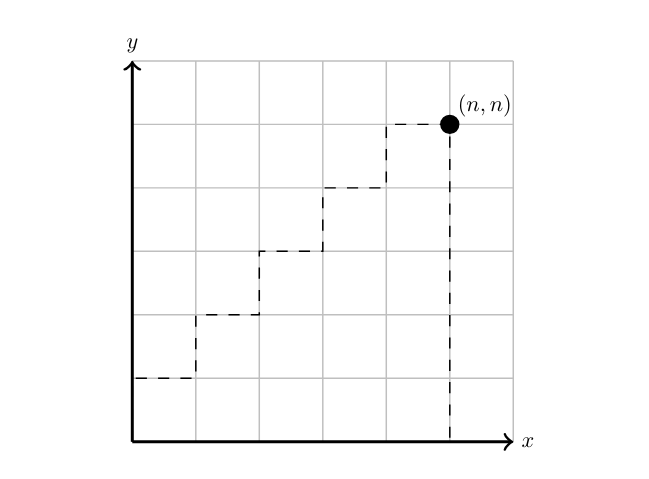
It is easy to see that the points of the staircase-like polygon can be expressed in terms of \(n\). Therefore the area can be expressed in terms of the Shoelace Formula.
$$ T_n=\frac{1}{2} \left| {\begin{matrix}0&0&1&1&2&\ldots&n-1&n&n&0\\0&1&1&2&2&\ldots&n&n&0&0 \end{matrix}} \right| $$$$ = \frac{1}{2} \left( \left| \begin{vmatrix} 0&0 \\ 0&1 \end{vmatrix} +\begin{vmatrix} 0&1 \\ 1&1 \end{vmatrix} +\begin{vmatrix} 1&1 \\ 1&2 \end{vmatrix}+\begin{vmatrix} 1&2 \\ 2&2 \end{vmatrix}+\begin{vmatrix} 2&2 \\ 2&3 \end{vmatrix} + \ldots + \begin{vmatrix} n-1&n-1 \\ n-1&n \end{vmatrix} +\begin{vmatrix} n-1&n \\ n&n \end{vmatrix} + \begin{vmatrix} n&n \\ n&0 \end{vmatrix} + \begin{vmatrix} n&0 \\ 0&0 \end{vmatrix} \right| \right) $$
Reduce the last two determinants:
$$ = \frac{1}{2} \left( \begin{vmatrix} 0&0 \\ 0&1 \end{vmatrix} +\begin{vmatrix} 0&1 \\ 1&1 \end{vmatrix} +\begin{vmatrix} 1&1 \\ 1&2 \end{vmatrix}+\begin{vmatrix} 1&2 \\ 2&2 \end{vmatrix}+\begin{vmatrix} 2&2 \\ 2&3 \end{vmatrix} + \ldots + \begin{vmatrix} n-1&n-1 \\ n-1&n \end{vmatrix} +\begin{vmatrix} n-1&n \\ n&n \end{vmatrix} -n^2 \right) $$Notice how every matrix in an odd position is just an increment of the first one; similarly, every matrix in an even position is an increment of the second one.
$$
\begin{aligned}
& \frac{1}{2} \left( \sum_{j=0}^{n-1} \begin{vmatrix} j & j \\ j & j+1 \end{vmatrix} + \sum_{j=0}^{n-1} \begin{vmatrix} j & j+1 \\ j+1 & j+1 \end{vmatrix} -n^2 \right) \\
& = \frac{1}{2} \left( \sum_{j=0}^{n-1} \left( \begin{vmatrix} j & j \\ j & j+1 \end{vmatrix} + \begin{vmatrix} j & j+1 \\ j+1 & j+1 \end{vmatrix} \right) - n^2 \right) \\
& = \frac{1}{2} \left( \sum_{j=0}^{n-1} \left[ j(j+1) - j^2 + j(j+1) - (j+1)^2 \right] - n^2 \right) \\
& = \frac{1}{2} \left( \sum_{j=0}^{n-1} [ -1 ] - n^2 \right) \\
& = \frac{1}{2} ( -n - n^2 ) \\
& \implies \boxed{T_n = \frac{n(n+1)}{2}}
\end{aligned}
$$
Since the Shoelace Formula represents oriented area, we are free to take the absolute value for geometric area.